Underwater Welding: The RM10k/Month Job No One Talks About
By Low Jing Hong, Editor, SuperJobs|Reviewed by Farah, Reviewer, SuperJobs
Published |Last reviewed
Hiring now: browse jobs in Malaysia on SuperJobs, updated daily.
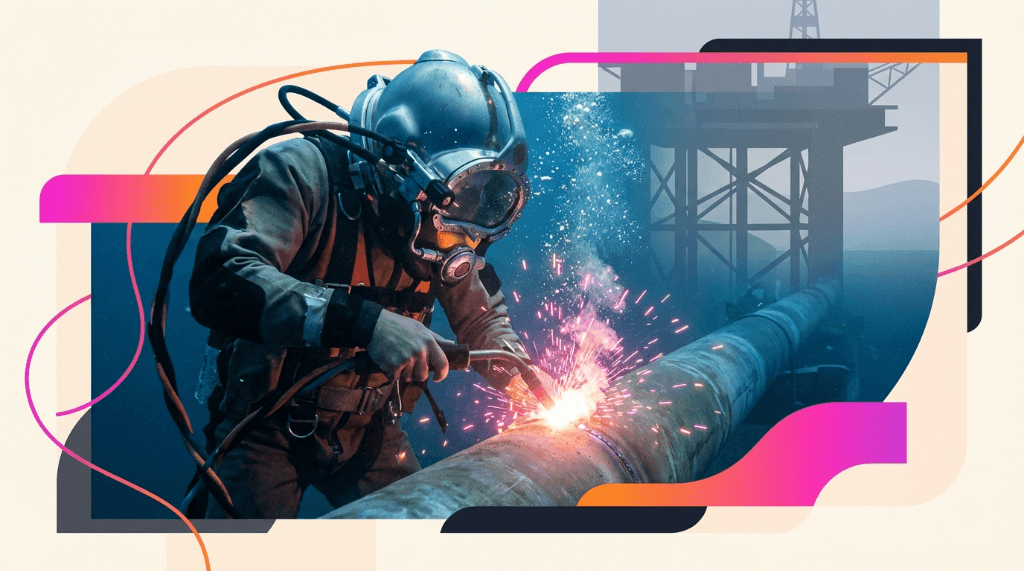
Quick Answer: Underwater welders in Malaysia earn RM 8,000–20,000 monthly in the offshore oil & gas sector, making it one of the highest-paying technical trades. This guide covers how to get certified, where to find work, and the risks involved.
In a 2026 job market where many fresh university graduates in corporate roles struggle to find starting salaries above RM 3,000, there is a specialized elite group of tradesmen quietly earning three to five times that amount—often before they even turn 25.
They are Commercial Diver-Welders, more commonly known to the public as Underwater Welders.
This is widely considered one of the most physically demanding and dangerous jobs in the world. But for those with the grit, discipline, and nerve to handle it, the financial rewards are massive. With Malaysia maintaining its position as a critical global hub for Oil & Gas (O&G) and maritime logistics, the demand for highly skilled local talent to maintain offshore rigs, subsea pipelines, and massive cargo ships is at an all-time high.
If you are tired of the traditional 9-to-5 desk job and are looking for a high-octane, high-paying career, this comprehensive guide breaks down the reality of the job, the salary potential, and the exact, rigorous certification path you need to take in Malaysia.
The Reality of the Job: It is Not Just "Swimming with a Torch"
The biggest misconception about underwater welding is that it's simply scuba diving while holding a sparkler. The reality is far more intense.
You are not merely a welder; you are a highly trained, elite construction and salvage worker who operates in an actively hostile environment.
You might find yourself working 50 meters underwater in pitch-black, freezing water in the South China Sea, repairing a critical structural crack on an offshore oil rig jacket. Alternatively, you might be dispatched to clear a fouled, massive propeller on a commercial cargo ship in the murky waters of Port Klang, navigating zero visibility where you can only work purely by touch.
The job utilizes two primary methodologies:
1. Wet Welding (SMAW - Shielded Metal Arc Welding)
This is exactly what it sounds like. You weld directly in the water using specialized, heavily waterproofed electrodes. The water around the weld boils instantly, creating a thick bubble curtain that further destroys visibility. It is physically grueling, requires immense arm strength to steady the equipment against strong ocean currents, and is typically used for rapid emergency repairs.
2. Dry Welding (Hyperbaric Welding)
This is a more complex, controlled operation. A massive, custom-built chamber is lowered and sealed completely around the damaged pipe or structure. The water is then pumped out, and the chamber is filled with a breathable gas mixture. The diver then enters the dry chamber to execute the weld. Because the environment is controlled, this produces much higher quality welds and pays significantly more, though it requires vastly more complex surface logistics and setup.
Salary Breakdown: How Much Can You Actually Earn in Malaysia?
Unlike salaried office jobs, commercial divers are almost always paid by the "project," "day rate," or "dive bonus"—especially when working offshore.
Entry-Level: The Inshore & Civil Sector (RM 3,000 - RM 6,000/month)
This is where 90% of all commercial divers start to build their mandatory logbook hours. Work typically involves inland or coastal civil engineering tasks: cleaning ship hulls at port, inspecting underwater bridge pillars, conducting maintenance in murky water treatment reservoirs, or retrieving lost heavy equipment. It is difficult, dirty work, but essential for gaining experience.
Experienced: The Offshore O&G Sector (RM 8,000 - RM 15,000+/month)
Once you have proven yourself and acquired your offshore medicals, you move to the rigs. Work involves pipeline tie-ins, installing subsea valves, and executing emergency structural repairs for major clients like Petronas, Shell, or ExxonMobil. Day rates can range from RM 500 to RM 1,000+ depending on the depth and danger of the dive.
The Elite 1%: Saturation Divers (RM 30,000 - RM 60,000+/month)
"Sat" divers live in a pressurized helium-oxygen chamber (both on the ship and in the diving bell) for up to 28 days straight. Because their bodies are continually pressurized to the depth of the ocean floor, they do not need to decompress after every shift, allowing them to work massive 8-hour shifts at extreme depths. This is the pinnacle of the profession. Peak season earnings for a 30-day "Sat run" can easily exceed RM 50,000, though these roles are reserved for the absolute best in the industry.
The Certification Path: You Need Two "Passports"
The barrier to entry is high, and intentionally so. You cannot just take a weekend PADI scuba course, buy a welding set from a hardware store, and jump in. Recreational diving certifications are strictly forbidden and legally unrecognized in commercial work.
To get hired by any reputable contractor, you need specific certifications recognized by the Department of Occupational Safety and Health (DOSH) and international maritime bodies.
Step 1: The Commercial Diving License
The foundational requirement is a recognized commercial diving course, typically accredited by ADAS (Australian Diver Accreditation Scheme) or HSE (Health and Safety Executive, UK).
- Cost: This is a heavy investment, typically costing between RM 25,000 and RM 45,000 for a full SSBA (Surface Supplied Breathing Apparatus) course.
- Where to Train: Accredited centers operating in Malaysia include Weldzone Training Centre and TWI Technology (S.E. Asia).
- The Medical Gatekeeper: Before you can even enroll and pay, you must pass a brutal, specialized commercial diving medical exam to ensure your heart, lungs, and ears can handle extreme pressure changes.
Step 2: The Welding Coding
Once you prove you can dive and survive safely, you must prove you can actually weld to a high industrial standard. You will typically test to the AWS D3.6M standard (Underwater Welding Code).
- Certifications: You will aim for recognized tickets like CSWIP 3.1U (Underwater Inspector) and welder qualification to AWS D3.6M, the American Welding Society's code for underwater welding.
- Local Compliance: The Construction Industry Development Board (CIDB) also offers skills competency assessments for welding levels 1-3, which are legally essential if you want to work on any local Malaysian construction projects.
The Real Risks: Why It Pays So Well (Danger Money)
The aggressive salary is not just for your skill; it is essentially "danger money." The mortality and severe injury rates are higher than almost any other trade. You must be hyper-aware of the specific hazards:
- Delta P (Differential Pressure): The invisible, sudden killer. If a pipe cracks or a valve is accidentally opened underwater, the pressure difference creates a massive, irresistible suction force. A diver caught in a Delta P scenario can be trapped instantly against the pipe or sucked into it. It is almost impossible to escape without surface intervention.
- Decompression Sickness ("The Bends"): Ascending too fast causes nitrogen bubbles to physically form inside your bloodstream and joints. Severe cases lead to paralysis or death.
- Electrocution: You are actively using hundreds of amps of electricity while completely submerged in conductive saltwater. While commercial equipment is heavily insulated and relies on a "double-pole" switch system controlled from the surface, faulty gear, a torn drysuit, or careless handling can be instantly fatal.
- Hypothermia and Exhaustion: Working in freezing subsea temperatures while managing heavy umbilical cords drains the body’s energy reserves at an alarming rate.
Next Steps to Enter the Trade
This career is absolutely not for the claustrophobic, the faint-hearted, or the undisciplined. But for those who are physically fit, technically minded, and possess unwavering focus, it is a fast track to rapid financial independence and global travel.
- Get Medically Cleared First: Do not spend a ringgit on courses yet. Start by scheduling a specialized Hyperbaric Medical Checkup with a DOSH-registered Occupational Health Doctor (OHD) to ensure you are legally and physically fit to dive commercially.
- Visit the Tanks: Contact training centers like TWI in Shah Alam or Weldzone in Seri Kembangan. Schedule a visit to see the training tanks and the heavy commercial gear in person to ensure it is what you really want.
- Explore Funding: It is a massive upfront cost. It is highly recommended to check your eligibility for PTPK (Perbadanan Tabung Pembangunan Kemahiran) skills loans or Yayasan Peneraju scholarships, which heavily fund high-value, critical TVET courses for Bumiputera candidates seeking to boost their income.
Find Trade Opportunities: Visit SuperJobs.my to browse highly technical and specialized skilled trade jobs in the maritime, construction, and oil & gas sectors across Malaysia.
Take the Next Step
- Browse oil & gas jobs on SuperJobs — live openings and hiring companies across Malaysia
- Browse tech jobs on SuperJobs — Find AI, software, and data roles in Malaysia
- Search salary benchmarks — Compare tech salaries across cities
- Plan your tech career — Get AI-powered recommendations
Related guides
- Advanced ManufacturingPenang and Kulim are experiencing a golden age of high-tech manufacturing. Explore the specialized roles driving "Industry 4.0" smart factories.
- Automotive Technician CareersThe Malaysian auto industry is going electric. Learn how to become an automotive technician with EV and hybrid skills: training, salaries and employers.
- Halal Blockchain AuditorForget simple inspections. The future of Halal auditing is blockchain. Learn how to verify the 'Digital Twin' of products and earn RM8,000+.