Agriculture and Agritech Careers in Malaysia (Yes, They're Hiring)
By Low Jing Hong, Editor, SuperJobs|Reviewed by Farah, Reviewer, SuperJobs
Published |Last reviewed
Hiring now: browse Information Technology jobs in Malaysia on SuperJobs, updated daily.
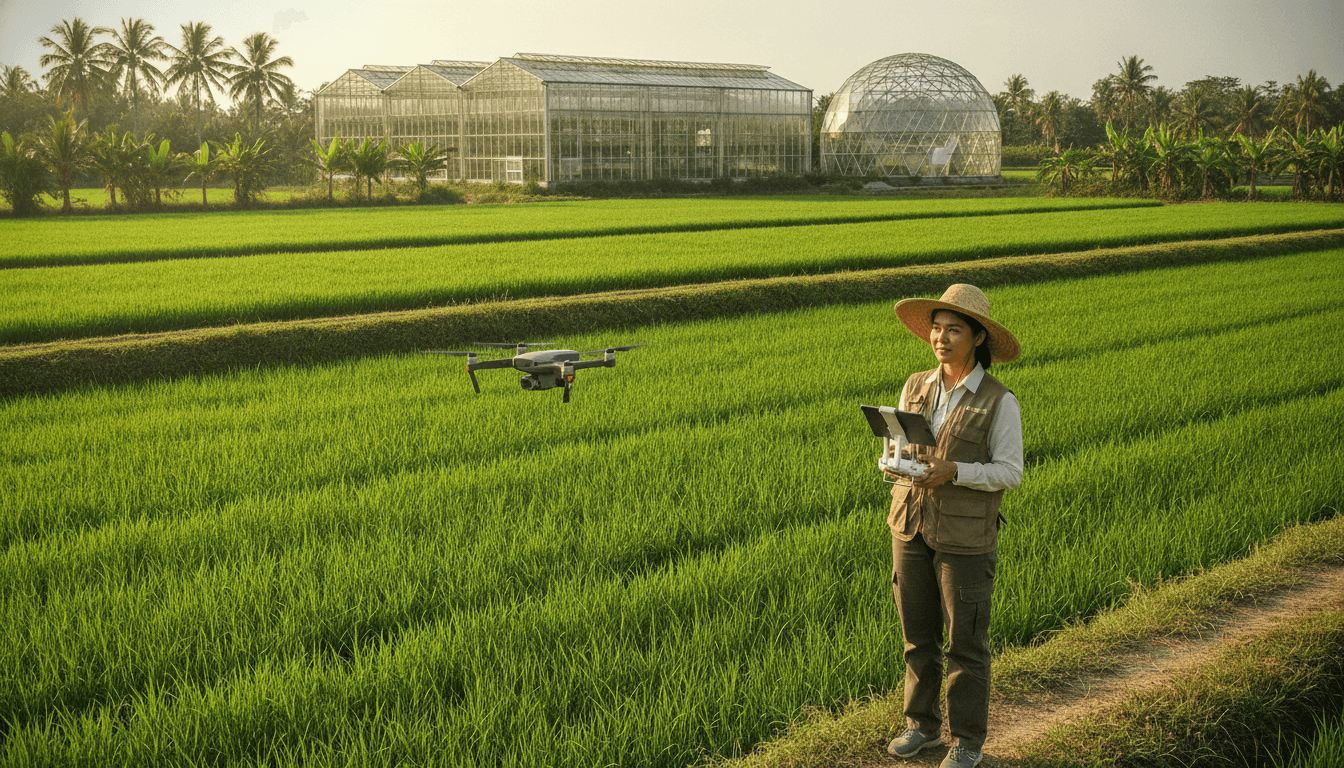
Quick Answer: Agriculture and agritech careers in Malaysia range from plantation management and agronomy R&D to drone operations, IoT farming and food security policy. Fresh graduates typically earn RM2,500–RM4,000 per month, with plantation cadetships at giants like Sime Darby and FGV offering housing and structured progression — and the national food security push is creating new roles yearly.
SuperJobs Insight: Malaysia imports a large share of its food — the food import bill has run above RM75 billion a year — which is exactly why the National Agrofood Policy 2.0 (2021–2030) is pouring investment into local production and agritech, and why this 'old' sector is hiring young talent again. Browse agriculture jobs on SuperJobs →
1. Why Agriculture Is a Sunrise Sector Again
That old 'sunset sector' label is reversing in 2026 for three reasons:
- Food security is national policy. The National Agrofood Policy 2.0 targets higher self-sufficiency in rice, vegetables, poultry and aquaculture — and policies need people to execute them.
- The workforce is ageing out. The average Malaysian farmer is in their late 50s; plantations and agencies actively court young graduates.
- Technology changed the job. Drones, IoT sensors and precision irrigation make modern agri roles look more like data and operations jobs than manual labour.
The result: genuine demand across estates, labs, startups and agencies — with less competition per opening than in oversubscribed sectors.
2. Traditional Agriculture Careers
The established backbone still hires at scale:
- Plantation executive / cadet planter: manage estate operations — harvesting, manpower, yields, MSPO/RSPO compliance. Cadetships usually include free housing, allowances and structured promotion to estate manager within 5–8 years.
- Agronomist: advises on crop nutrition, soil health and yields for plantations and input companies.
- R&D roles: MPOB, MARDI and corporate research centres hire agriculture, biotech and chemistry grads.
- Agri technical sales: agrochemical and seed companies (Bayer, Syngenta, local players) hire fresh grads as technical reps — good pay plus field exposure.
Be realistic: estate roles mean living on-site in rural areas. The trade-off is low living costs, fast savings and early management responsibility.
3. Agritech and Precision Farming Careers
Where agriculture meets tech — and where demand grows fastest:
- Drone operations: spraying, mapping and crop-health imaging. Commercial operators need CAAM certification; agritech service firms train and hire pilots and analysts.
- IoT and smart farming: sensor networks for soil, weather and fertigation in smart greenhouses and vertical farms — field technicians to systems engineers.
- Farm data analysis: turning drone and sensor data into yield predictions — ideal if you pair agri knowledge with Excel/Python.
- Agritech startups: ventures in farm software, urban farming and traceability (backed by MDEC and MYStartup programmes) hire ops, tech and BD roles.
Positioning tip: people who speak both agronomy and data are rare and get hired fast. Plan a hybrid skill path with the SuperJobs Career Planner.
4. Aquaculture and Fisheries Careers
Aquaculture is a priority growth area under the food security agenda, supported by the Ministry of Agriculture and Food Security (KPKM) and the Department of Fisheries:
- Hatchery and farm technologists: breeding and grow-out operations for shrimp, tilapia and grouper farms in Perak, Penang, Sabah and Johor.
- Health and nutrition roles: feed and aquatic health companies hire fisheries and biotech grads.
- Research: universities (UMT, UPM, UMS) and agencies run programmes with pathways into government and industry.
- Processing and export QA: HACCP and export certification roles are steady hirers.
Entry pay is modest (RM2,300–RM3,200) but experienced farm managers and specialists are scarce and well compensated.
5. Food Security, Policy and NGO Roles
Not every agri career involves boots in the field:
- Government agencies: KPKM, DOA, FAMA, MARDI and LPP hire officers for extension services and policy implementation via SPA intake.
- Policy institutes: think tanks and university centres work on food security economics and climate adaptation.
- NGOs and social enterprises: smallholder livelihoods, food waste and community farming programmes — typically RM2,500–RM3,500 to start.
- Sustainability and certification: MSPO/RSPO auditing, ESG reporting and traceability — a growing white-collar track.
These roles suit agribusiness economics, environmental science and public policy grads too.
6. Top Employers: Sime Darby, IOI, FGV, Genting Plantations
The big four plantation groups anchor graduate hiring:
- SD Guthrie (formerly Sime Darby Plantation): the world's largest oil palm planter by certified sustainable output; structured cadet and graduate programmes.
- IOI Corporation: integrated plantation and downstream operations; cadets, engineers and R&D.
- FGV Holdings: among the largest crude palm oil producers globally; large annual intakes across estates, mills and corporate.
- Genting Plantations: plantations plus downstream; known for solid cadet training.
Beyond the big four: KLK and United Plantations; MPOB and MARDI for research; Bayer and Syngenta for inputs; plus agrofood giants like QL Resources and Leong Hup. Compare employers on SuperJobs company pages.
7. Salary Ranges by Role
Indicative monthly figures as of 2026:
| Role | Fresh grad (RM) | 4–7 years (RM) |
|---|---|---|
| Cadet planter / plantation executive | 2,800 – 3,800 (+ housing) | 5,000 – 8,000 (estate manager track) |
| Agronomist | 2,800 – 3,800 | 5,000 – 7,500 |
| R&D officer (MPOB/MARDI/corporate) | 2,600 – 3,600 | 4,500 – 7,000 |
| Agritech / drone / IoT specialist | 2,800 – 4,000 | 5,000 – 8,000 |
| Aquaculture technologist | 2,300 – 3,200 | 4,000 – 6,500 |
| Agri technical sales | 2,800 – 4,000 (+ commission) | 5,500 – 9,000 |
| Sustainability / certification executive | 2,800 – 3,800 | 5,000 – 7,500 |
Remember that estate packages include housing and allowances that meaningfully raise effective income. Benchmark against live data on SuperJobs Salary Insights.
8. Skills, Degrees and Certifications That Matter
Degrees that map directly: agriculture science, agribusiness, plantation management (UPM is the flagship; UMK, UMS, UniSZA and UiTM are strong), biotech, fisheries and agricultural engineering. Adjacent degrees work too — business into agribusiness, engineering into mills and automation, IT into agritech analytics.
Certifications that lift your CV:
- MSPO/RSPO awareness — sustainability certification knowledge is now assumed for plantation roles.
- Drone certification (CAAM) for precision agriculture work.
- Data basics: Excel modelling, GIS fundamentals, and Python or Power BI for agritech roles.
- HACCP/food safety for agrofood processing and QA tracks.
- BM + English fluency — estate and extension work is people work.
Tailor your CV to each subsector's keywords with the SuperJobs CV Checker.
Take the Next Step
- Browse agriculture and agritech jobs — plantation, R&D, drone and agrofood roles across Malaysia
- Check salary benchmarks — compare agri sector pay before you negotiate
- Explore top employers — research SD Guthrie, IOI, FGV, Genting Plantations and more
- Plan your career path — map a hybrid agri + tech skill route
Live on SuperJobs: IT jobs in Malaysia
Data from SuperJobs postings, October 2026.
| Open roles now | 605 |
|---|---|
| Advertised monthly pay (25th / median / 75th percentile) | RM3,500 / RM4,338 / RM6,500 (n = 60) |
| Internship allowance (25th / median / 75th percentile) | RM762 / RM925 / RM1,144 (n = 30) |
| Top hiring companies | Accenture Malaysia (100), Cognizant Malaysia (26), Fuji Xerox Malaysia Sdn Bhd (23), AIA Malaysia (Insurance) (15), PwC (12) |
Pay figures are the midpoints of salary ranges that employers chose to publish. How we calculate this.
?Frequently Asked Questions
Is agriculture a good career in Malaysia in 2026?
Yes — the national food security push, an ageing farm workforce and agritech investment have made it a genuine growth sector. Competition per opening is lower than in popular sectors, plantation careers offer housing and fast progression, and hybrid agri-tech skills are in short supply.
How much do plantation executives earn in Malaysia?
Cadet planters and junior plantation executives typically earn RM2,800–RM3,800 per month plus free estate housing and allowances. Progression is structured: assistant managers earn around RM4,000–RM6,000, and estate managers RM6,000–RM10,000+ depending on the group and estate size.
What is agritech and what jobs does it offer in Malaysia?
Agritech applies technology — drones, IoT sensors, data analytics and farm management software — to farming. Malaysian agritech jobs include drone pilots and imaging analysts, smart-farm technicians, agronomist-data hybrids and roles at agritech startups supported by MDEC and MYStartup programmes. Fresh grads earn around RM2,800–RM4,000.
Apakah peluang kerja untuk graduan pertanian di Malaysia?
Graduan pertanian boleh memohon jawatan kadet peladang di syarikat seperti SD Guthrie, IOI dan FGV, jawatan penyelidik di MARDI dan MPOB, kerja agritech (dron, IoT), akuakultur, jualan teknikal agrokimia, serta jawatan kerajaan melalui SPA. Gaji permulaan biasanya RM2,500–RM4,000 sebulan, dengan perumahan percuma untuk kerja estet.
Can I work in agriculture without an agriculture degree?
Yes. Business graduates enter agribusiness and technical sales, engineers work in mills, irrigation and automation, and IT/data graduates power agritech analytics. Plantation groups also accept diverse degrees into cadet programmes. What matters is willingness to work in rural postings and to learn the crop fundamentals on the job.
Related guides
- Digital Marketing CareersDiscover digital marketing roles, skills, certifications, and salary expectations.
- Biotech & Digital TherapeuticsSoftware as Medicine? Digital Therapeutics (DTx) and Biotechnology are merging software with biology. Explore the most cutting-edge jobs in Malaysia's health sector.
- Teaching CareersConsidering a teaching career in Malaysia? Explore public, private, international school and edtech roles, salaries, and qualification requirements.